Archive Record
Images
Metadata
Catalog Number |
2010.1.10 |
Object Name |
Certificate, Achievement |
Title |
Certificate of Merit |
Date |
04/10/1948 |
Description |
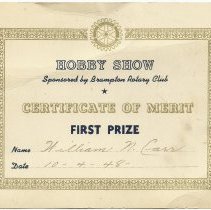
A first place prize certificate of merit awarded to William Carr from the Hobby Show presented by the Brampton Rotary Club. The certificate was issued April 10, 1948. The certificate has a rotary wheel on the top in a gold and a matching decorative border. |
History |
In 1948, William "Bill" Carr presented a handmade train model of Stephenson's "Rocket," the first steam engine in Britain, at the Hobby Show sponsored by the Brampton Rotary Club. The model won first place on April 10 of that year. It was made entirely from paper and used application sticks provided to Bill Carr by a family friend, Dr. J.T. Speck of Greaves Avenue (renamed Grenville Avenue in 1956), Cooksville. Stephenson’s "Rocket" was the first modern steam locomotive, developed during a brief but intense period from 1828 to 1830. The year 1830 marked the opening of the world’s first inter-city passenger railway, the Liverpool & Manchester Railway, and prospective train designers and manufacturers anxiously competed to see which locomotive would be the first to grace its tracks. A trial was held at Rainhill, Merseyside, in October 1829 to select a contractor to build the locomotives for the railway. Of the 10 entries, only five locomotives actually appeared, and of these, only the "Rocket" completed the trial, winning the £500 prize and the contract. Built by Robert Stephenson & Co. in Newcastle upon Tyne, the "Rocket," inspired by the speed of military rockets, incorporated a number of new features, most notably the first use of a multi-tube boiler and separate firebox. Its advanced design became the blueprint for all steam locomotives built in Britain until the 1960s. Trains not only revolutionized Canada in the 19th century by connecting the country from west to east, but they also became a thrilling symbol of innovation seared into the public consciousness. The image of the last spike of the Canadian Pacific Railway, hammered in 1885, became a symbol of national unity. As a result, children's toys depicting these marvels quickly gained popularity and remained beloved by generations of children. Reflecting on his childhood, Bill said, "There was no money, because I was a Depression child, and I guess I was like other kids—I wanted toys and trains and planes and trucks and this kind of stuff, and no matter what I wanted, I was told there was no money. And there wasn’t. You know, we could buy bread for four cents a loaf—and we didn’t have the four cents." |
References |
"Model of Stephenson's Rocket", National Museums Scotland, Retrieved from: https://www.nms.ac.uk/explore-our-collections/stories/science-and-technology/model-of-stephensons-rocket/ |
People |
Carr, William |
Search Terms |
City Centre Cooksville |
Relation |
Show Related Records... |